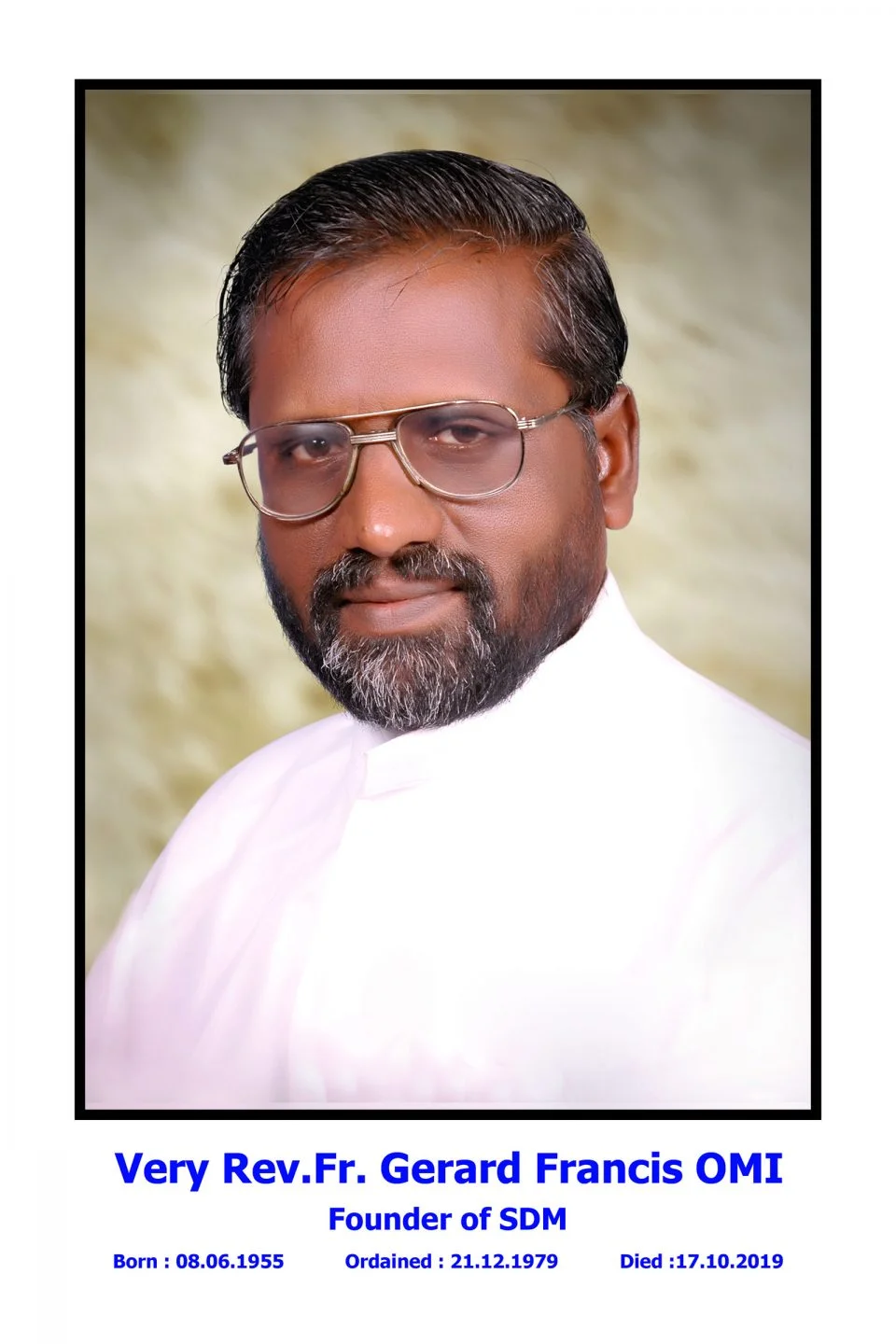
VERY. REV. FR. GERARD FRANCIS OMI
Our Lord is the Lord of history. He guides the economy of salvation, an ongoing God-driven mission, through his messengers, prophets and shepherds. The story has its suspense, agony and ecstasy. The journey has its thrill till the people reach the destination. Quite often, the discomforting question is, ‘Whom shall I send?’ (Is 6:8). But to our surprise, the right people after God’s own heart come forward saying, ‘Here am I; send me!’ Any prophetic call is the response to the cry of the people in agony. It is well depicted in the call of Moses: ‘And now the cry of the Israelites has reached me, and I have seen the way the Egyptians are oppressing them. So, now, go. I am sending you to Pharaoh to bring my people, the Israelites, out of Egypt.’
The present fast technological world is literally in crisis, and it is need of a saviour. The socially stratified and caste-ridden society had no sense of equality and fraternity. The lower classes are severely affected by the system. The children in the villages have less access to education. The women in the villages are still restricted to the kitchen and enclosures. The poor, the sick, the old and the widows are badly affected by diseases and other social and economic discriminations. At this crucial juncture, God chose Rev. Fr. Gerard Francis OMI and sent him to script a new momentum in the life of the Indian Church. He was well trained by the selfless Missionary Oblates of Mary Immaculate and was in the good company of Rev. Fr. Amal Raj and Rev. Fr. Arul Raj, the first fruits of the Indian Oblates of Mary Immaculate. They found that a lot of good had not happened in the Indian Church very especially in the Church of Tamil Nadu, owing to the absence of an indigenous religious community. The rest is history and the resurgence of the Church in crisis to a Church of blessings.
Advent of a Humble Soul
Centuries might pass; seasons might change, but men of God experience always a painful longing for their divine master. The life of Rev. Fr. Gerard Francis OMI, a humble and simple soul of Indian (Tamil Nadu) soil, was nothing but God becoming everything for him. It was this God experience that helped him to consider himself an unworthy servant of God. He felt even at the moment of agony and fear of death, God was in search of him and extended His hands to embrace him. Hence, it is really essential to know about this chosen oblate to travel the less-travelled road of love.
Very Rev. Fr. Gerard Francis OMI was born on June 8, 1955, in Kodaikanal. It is a hill station which is located in Dindigul district in the state of Tamil Nadu. Its name in the Tamil language means ‘The gift of the forest.’ It is referred to as the ‘Princess of hill stations.’ It has a long history as a retreat and popular tourist destination. The life of the people in Kodaikanal during the olden days was in misery due to poverty and contagious diseases. It was in that context that Fr. Gerard was born. The family of Francis and Philomena was showered with God’s blessings, and infant Gerard was the firstborn among three children in the family. His father was a Hindu convert, and his mother was a Muslim convert; both were touched by God and became Catholics. Even in the midst of all difficulties, children grew up in the shadow of their loving parents with real faith in God and love for others. For the virtuous life of little Gerard, his family was a real blessing from God.
The Divine Call to be an Oblate
‘Where the needs of the world and your talents cross, there lies your vocation.’ Having realised the desperate situation and the utmost need of the people, the constant inspiration of the Holy Spirit and the motivation of his parents enabled him to join the Congregation of the Oblates of Mary Immaculate to love and serve the Lord and the humanity through the sacred order of Priesthood. ‘Formation is an important part of the discernment process and offers a tremendous opportunity for personal development.’ The oblate formation helped him to grow spiritually and emotionally, step by step, as he gained greater insights into religious and community life. It also enabled him to prepare for a commitment to serve God’s people as an ordained priest on December 21, 1979. As a young and vibrant priest, he journeyed to Bangladesh as a missionary and served 10 years among the tribals with full energy and enthusiasm. Later, he returned back to Tamil Nadu, India and served as the Parish Priest of St. Joseph’s Mission Church, Podhaturpet, one of the remotest parishes in the Archdiocese of Madras-Mylapore. He ardently served many people beyond caste and creed who were living in poverty; many children were not cared for by parents, uncared widows, sick people and senior citizens.
The Inspiration to Initiate the Society for the Poor
The initiation of the Society of St. Eugene de Mazenod has its roots in the life of St. Eugene de Mazenod. As a seminarian, he loved to read the life history of St. Eugene intensively. The love and compassion of St. Eugene towards the poor and the needy touched him very much. A deep desire arose within him to live like his founder St. Eugene. When his non-Christian parents became Catholics, their close relatives abandoned them, and all help was denied. At this juncture, the Providence of God played a major role in his life. An unknown Australian lady adopted him and rendered her selfless help till her death. This was very much haunted as a thought in him, ‘I was helped in my need, and it is my turn to help others in their need.’
A wonderful opportunity came when he met orphans in Bangalore. Moved with compassion, he wanted to help them. He tried in the orphanages and boarding schools, but none of them came forward to accept and help them. His one week of tireless search became vain. He was deeply hurt by the children’s utter helplessness. A voice within impelled him to start a Society to help the helpless. Without any pre-planning, trusting in the Providence of God and in the guidance of Mother Mary, heeding to the call, ventured to fulfill his desire as a vision and mission of God. This gave birth to the infant indigenous Society of St. Eugene De Mazenod to live as the poor in solidarity with the poor to experience the poor Infant Jesus in the Manger. There is a ray of hope for millions of helpless children to find a home in the Society.
The Origin of the Society of St. Eugene De Mazenod
The cry and agony of the people urged him to start a religious Society of St. Eugene De Mazenod at New Keechalam, in the archdiocese of Madras-Mylapore, to serve the poor and the needy. He started the Society with three young boys with the motto to love the unloved, which has its root in the life of St. Eugene De Mazenod, who was basically concerned with the welfare of the widows, orphans, marginalised and most backwards rural people in his time. St. Eugene’s love and compassion towards the poor and the needy touched him very much. As a young boy, Eugene moved with pity, offered his cloak to a poor charcoal worker and took up their cause for development. Later, as a priest, he took great care of the orphans and nurtured them. He also had a special concern for the children of widows and the welfare of women abandoned.
On seeing his realistic commitment, a deep desire had arisen within him to live like his founder. He discerned the gentle voice of God to serve the most uncared children at risk and the widow, who has their children to be looked after. The experiences recorded in the book of Deuteronomy had guided his vision that a true religion is to serve the orphans and widows and the most downtrodden. He lived the charism of our Society until his last breath and set an example for all the members of our Society.
Call to Journey the Less Travelled Road of Love
The road less travelled is the road of love. The invitation to walk along the less-travelled way, which is the road of love purchased at the cost of Jesus’ own blood, draws together as the Society of St. Eugene De Mazenod. His divine plan is that all the people, without creed, caste, nationality and division, must travel along it and reach His Kingdom. Jesus is both the Way (road of love) and the Destiny, which is the Reign of God. He thus invites us to follow him and to share his mission of love through word and deed. Mother Teresa of Calcutta once said, ‘I think the world today is upside down and is suffering so much because there is so very little love in the world.’ Fr. Gerard agrees with her to the core. As a result of a lack of love, man begins to live in difficulty, insecurity and painful times. Instead of walking along the Way, he paved his own ways which lead to damnation (Mt 7:13). Fr. Gerard further says that man, puffed up by technical and scientific progress and put himself in the place of God and has built a new secular civilisation. The radical rejection of walking along the way of love is the real illness of modern-day society. This illness deafens the cry of the voiceless, poor and the marginalised. This illness blinds him to see Christ in the less fortunate children, abandoned and the destitute. This illness brings division among religions and nations.
Faced with such a deplorable situation, having heard the cry of the inner voice, Fr. Gerard urged the sons of St. Eugene De Mazenod to walk along the less travelled way of love and love everyone unconditionally, especially the smallest, the poorest, the least, the desperate, the marginalised and the out caste. He stressed to his sons that this is a call, this is our mission. Christ through His Church earnestly appeals to us that through our lives to rekindle the flame of love that has all but dying in the hearts of so many destitute children. This is a great undertaking, and a vast field lies before us. Do you feel it? We are human, feeble and unworthy. Trusting in the Divine Providence and taking refuge at the Immaculate Heart of Mary, the greater task is possible. He wished his beloved priests and brothers to consecrate with him to our Mother Mary, who is our strength and guide. The Constitution of the Society of St. Eugene De Mazenod is a guideline along the path of love, which is less travelled. By living this, we may obtain all the benefits we need to walk along the path and lead people of all walks of life to the goal, which is the Reign of God.
Voyage to the Father’s Home
The people experiencing the most pain tend to be the ones who are always trying to make others smile. He suffered physically for many years due to various ailments yet never stopped his humble and simple service to the people in need. He often says that ‘I do not want to die soon because in Heaven there is no suffering. I desire to live a long time because I yearn to suffer much for the love of Christ. The essence of Catholic suffering teaches that although suffering in itself is not inherently good for our souls. Suffering refines us and helps us to get into heaven if we allow it. He underwent incredible suffering physical, spiritual and emotional. His suffering has seemed to be beyond human endurance. It has been so intense at times. We have wondered how he could go on without collapsing under the burden of it all. Finally, on October 17, 2019, he gave thanks to God for the gift of life on earth and received blissful, serene and everlasting life in Heaven.
A Lovely Fruit Bearing the Branch of Jesus
Jesus invites us to be the true branches that are united to Him. No external qualification can set a human right with God; only the fellowship of Jesus Christ can do that. We have an exemplary model in the life of Fr. Gerard for being united with Jesus. In the light of the gospel passage of John 15:1-10, the life of Fr. Gerard could be well understood as a lovely fruit bearing branch of Jesus. Certainly, Jesus will depict him as a lovely fruit bearing branch of Him. Because of our limited understanding of the amazing personality of Fr. Gerard leads us to the truth that Fr. Gerard had nothing except the joy and friendship of belonging to Jesus. Let us gratefully reflect on the humble life of such a simple oblate. Though our understanding is very limited, Fr. Gerard’s life could be summed up in the following reflections: 1. A life of deep and intense prayer, which thought and acted far ahead of our times. 2. A man who lived in the light of the vision of God. 3. A Charismatic leader who laid down his life in the service of God through the unique service of unidentified humanity.
The saying of St. Ireneus, ‘Glory of God is human fully alive, and life of man is the vision of God,’ is very meaningful to understand the total transformative effect of the life and contributions of Fr. Gerard. He had a realisation that life in man is the Glory of God, and it needs to be fully alive. Today, the Sons of St. Eugene De Mazenod enjoy the fruits of the toil of our beloved Fr. Gerard, who dared to take the road less travelled by, following the Divine Master, who dreamt the dreams of God. St. Paul says, ‘I pray that you may have the power to comprehend with all the saints what is the breadth, length, height, depth, and to know the love of Christ that surpasses all knowledge (Eph 3:18).’ These words were realised in this man of God. He could experience the breadth, length, height and depth of God’s love. The force of His love is so overwhelming and overflowing that his actions became so spontaneous and Godly.
The shadow of his divine personality falls on all people irrespective of caste, creed and sex. Those who lead by the Holy Spirit are God’s children. Looking at the blessed path of this blissful person, all cannot but call him God’s own. Lord Jesus, your servant Fr. Gerard walked ahead of us in your path, the path of your word. Your words incarnated in him, and he became the paradigm of your powerful words. Lord Jesus, help us so that your words take flesh in us, your children, assimilating them into our very persons and lives.